
Company News
From Intelligent Microfluidics to Micro/Nano 3D Printing: East China University of Science and Technology Achieves Automated Generation of Hydrogel Microcapsules
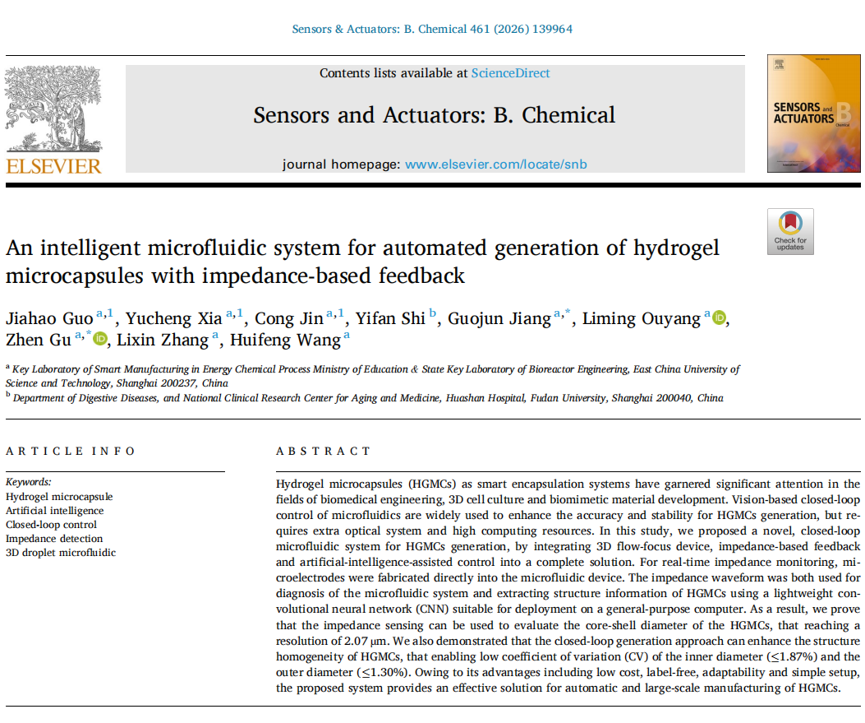
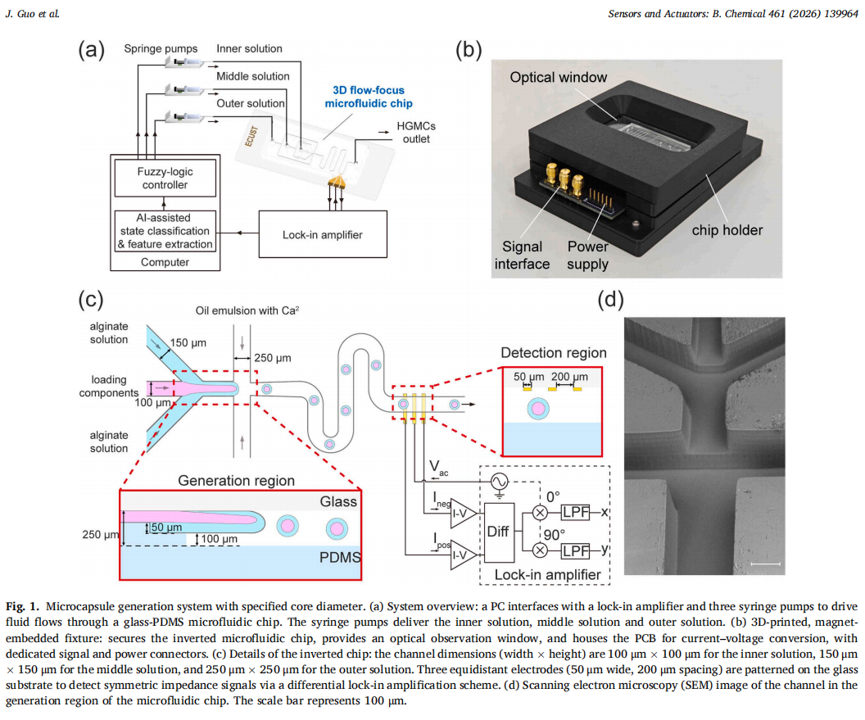
Traditional microfluidic chip fabrication is precise but slow; intelligent closed-loop control systems are efficient but constrained by manufacturing bottlenecks. This seemingly contradictory pair has found a point of convergence in recent research by a team from East China University of Science and Technology. In collaboration with Huashan Hospital affiliated with Fudan University, the team published the study An intelligent microfluidic system for automated generation of hydrogel microcapsules with impedance-based feedback in Sensors and Actuators B: Chemical. The team successfully built an intelligent closed-loop microfluidic system integrating a 3D flow-focusing chip, impedance sensing, and AI-assisted control, achieving high-precision and fully automated generation of hydrogel microcapsules. The key 3D flow-focusing microfluidic chip was precision-fabricated using the MP-100-6L micro/nano 3D printer from Shanghai Prismlab Technology Co., Ltd. ("Prismlab").
From Sensing to Control: Three Breakthroughs in Microcapsule Manufacturing
Hydrogel microcapsules (HGMCs), as smart encapsulation systems, have attracted growing attention in 3D cell culture, targeted drug delivery, biomaterials development, and other fields. However, precise structural control has long been affected by solution-viscosity fluctuations, changes in curing conditions, pump-speed deviations, and other factors, resulting in uneven microcapsule size or even failed generation.
The study's breakthrough lies in a three-way synergy of sensing, intelligence, and manufacturing:
Impedance sensing as an alternative to optical imaging: conventional approaches rely on high-speed cameras and image recognition, which require bulky equipment, consume significant computing resources, and struggle to distinguish core-shell structures with similar refractive indices. The research team innovatively integrated microelectrodes directly into the microfluidic chip, enabling real-time monitoring of each generated microcapsule through impedance waveforms and delivering label-free, low-cost, and high-sensitivity online detection.
AI-enabled real-time state recognition: the team designed a lightweight convolutional neural network (CNN) that converts impedance time-series signals into two-dimensional images for feature extraction. The system can identify six microfluidic states in real time - normal, bubbles, unstable, non-encapsulated, reflux, and oversized - with a classification accuracy of up to 97%, and it can run on a standard computer without GPU acceleration.
Fuzzy-logic closed-loop control: to address the nonlinear and time-delay characteristics of microfluidic systems, the team replaced conventional PID control with a fuzzy logic controller (FLC) to dynamically regulate inner-phase flow rate. Through a dynamic weighting strategy, the system responds rapidly under high-error conditions and converges smoothly when approaching the target value, ultimately achieving ultra-high consistency with an inner-diameter coefficient of variation of <=1.87% and an outer-diameter coefficient of variation of <=1.30%.
Prismlab Micro/Nano 3D Printing Turns High-Precision Chips from Design into Reality
The hardware foundation of this intelligent system - the 3D flow-focusing microfluidic chip - was fabricated using a mold precision-manufactured by Prismlab's sub-pixel micro-scanning 3D printing technology.
How Does Prismlab Micro/Nano 3D Printing Empower Advanced Microfluidic R&D?
Ultra-high precision for micron-scale channels: 5-micron precision enables precise forming of three-dimensional microchannels, with minimal channel-size error and high surface smoothness, ensuring stable flow fields and reliable impedance signals.
Freedom of 3D structural fabrication beyond 2D limits: chip structures can be printed in a single step without multilayer bonding, greatly reducing assembly errors.
Mold-free rapid iteration, shortening R&D cycles from days to hours: from CAD design to chip-mold forming, the process takes only a few hours. No masks, photolithography, or repeated mold opening are required; researchers can design, print, and use the chip rapidly to optimize channel structures.
Controlled cost and suitability for batch R&D: balancing precision and cost, the technology provides a feasible path for microfluidic chips to move from laboratory research toward scalable manufacturing.
Domestic Micro/Nano 3D Printing Empowering Frontier Innovation
From precision forming of microchannels, to accurate construction of capillary networks in organ-on-chip systems, to batch production of medical microdevices and semiconductor components, Prismlab's micro/nano 3D printing technology provides a solid foundation from design to mass production for the integration of microfluidics with intelligent and automated manufacturing. It also provides hardware support for the implementation of technologies in 3D cell culture, targeted drug delivery, and biomaterials development.
In 3D cell culture, the technology enables high-precision and automated preparation of microcapsule carriers, providing a stable microenvironment for cell growth, improving repeatability and success rates, and supporting cell biology research. In targeted drug delivery, it enables precise preparation of drug-loaded microcapsules for targeted delivery and sustained release, improving delivery efficiency and precision and supporting precision medicine research. In biomaterials development, it enables customized preparation of microcapsule carriers with specific structures and properties, providing a precision fabrication solution for new biomedical materials and driving innovation in the biomaterials field.
Localization, high precision, and high efficiency are more than Prismlab's technology labels; they represent a source of momentum for global scientific research and industrial innovation against the broader backdrop of China's high-end manufacturing upgrade.