
Company News
Joint Research by Huazhong University of Science and Technology, Northwestern Polytechnical University and Southeast University Published in Angiogenesis Uses Prismlab Micro/Nano 3D Printing to Precisely Build Microvascular Networks
Microvascular networks, the "life transport network" of the human body with a total length of up to 100,000 kilometers, are responsible for oxygen exchange, nutrient delivery, and metabolic waste removal. In tumor invasion, diabetic complications, neurological diseases and many other pathological processes, abnormal microvascular networks often play a critical role in disease progression. Yet accurately reconstructing this complex system in vitro, both structurally and functionally, has remained a core challenge in biomedical engineering. Conventional microfluidic chips typically simulate only simple unidirectional flow, while in real physiological environments, interstitial fluid moves in multidirectional, dynamic, and complex patterns. What impact does this multidirectional interstitial flow have on microvascular development? And how can a chip platform capable of generating such complex flow be manufactured?
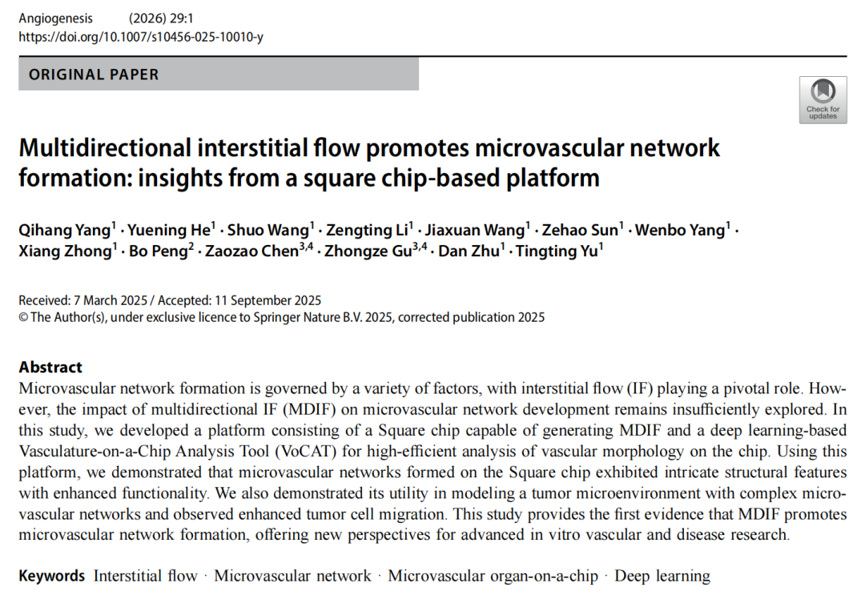
The study Multidirectional interstitial flow promotes microvascular network formation: insights from a square chip-based platform, jointly completed by Huazhong University of Science and Technology, Northwestern Polytechnical University, and Southeast University, was published in the internationally renowned journal Angiogenesis. In the research, the team used the MP-36-3L equipment from Shanghai Prismlab Technology Co., Ltd. ("Prismlab") to fabricate a square microfluidic chip mold with four-channel phase-guide structures, providing robust manufacturing support for vascularized organ-on-chip systems and tumor microenvironment studies.
From Unidirectional to Multidirectional: A Paradigm Shift in Microvascular Research
Most existing organ-on-chip studies use a three-channel parallel design, where medium channels on both sides create a pressure difference and generate unidirectional interstitial flow in the central hydrogel region. This design is simple and stable, but it cannot fully reproduce the complex situation in which fluid infiltrates cells from multiple directions in real tissues.
In the brain, interstitial fluid flows asymmetrically through highly tortuous spaces between neurons and microvessels. In tumor microenvironments, elevated interstitial flow drives angiogenesis and cancer cell migration. These multidirectional and dynamic flow patterns are the blind spots that conventional chip designs cannot address.
The study's breakthrough lies in a three-way synergy of chip design, flow regulation, and intelligent analysis:
Chip-structure innovation: a square hydrogel chamber measuring 3 mm x 3 mm was designed, with four medium channels arranged around it and precisely connected to the hydrogel region through phase-guide structures. Compared with traditional micropillar structures, phase guides demonstrated better stability and easier demolding in 200-micron-thick channels.
Multidirectional flow generation: by adjusting the hydrostatic pressure difference between opposing channels (60 Pa, dual-inlet mode), the team generated complex multidirectional interstitial flow within the hydrogel, with an average flow angle of 44.1 degrees - far exceeding the 2.1 degrees achieved by unidirectional-flow chips.
Intelligent analysis: a lightweight UNet-based VoCAT analysis tool was developed to enable high-throughput and high-precision morphological quantification of 3D microvascular networks.

Prismlab 3D Printing: Enabling Precise Fabrication of Complex Microfluidic Chips
The successful implementation of this technology relies on the key support of Prismlab's sub-pixel micro-scanning 3D printing equipment. The research team used Prismlab's sub-pixel micro-scanning 3D printing technology to fabricate a high-precision mold for the square chip, which was then replicated to form a PDMS microfluidic chip.
The core manufacturing challenge lies in the phase-guide structures. These precision microstructures, 50 microns high and 150 microns wide, act as "gates" between the hydrogel channel and the medium channels: they must ensure fluid connection while preventing hydrogel leakage. Traditional photolithography faces bottlenecks such as long production cycles, high cost, and limited design freedom when fabricating high-aspect-ratio, cross-scale, complex three-dimensional structures of this type.
Prismlab's sub-pixel micro-scanning technology overcomes these limitations:
2-micron precision: a microlens array reduces the beam to a sub-pixel-level spot, while piezoelectric ceramic micro-vibration scanning enables precise curing and forming of ultra-fine patterns. The 150-micron-wide phase guides and 200-micron channel height in the chip were accurately reproduced.
2-micron layer-thickness capability: ultra-thin layer printing supports complex three-dimensional structures with fine features, meeting the stringent cross-sectional morphology requirements of microfluidic chips.
Mold-free rapid iteration: from chip-mold design to 3D printing, the process can be completed within hours, without photomasks or cleanroom environments required by conventional photolithography. Researchers can rapidly iterate and optimize chip geometry, from channel width to phase-guide angle.
This combination of precision, design freedom, and efficiency enabled the square chip platform to be rapidly realized, bringing the in vitro simulation of multidirectional interstitial flow from concept to reality.
Broad Application Prospects: From Vascular Chips to Precision Medicine
Prismlab's micro/nano 3D printing technology is playing an increasingly important role across frontier research fields. We remain committed to providing researchers with high-precision, high-efficiency, and high-reliability micro/nano manufacturing solutions, supporting China's scientific and technological innovation and advancing industrial upgrading.
In the organ-on-chip field, the value of Prismlab micro/nano 3D printing is being released at an accelerating pace:
Microfluidic chip molds: rapid fabrication of PDMS chip molds with complex three-dimensional cavities, phase guides, micropillar arrays, and other fine structures.
Vascularized organ models: support for constructing complex in vitro models such as the blood-brain barrier, tumor microenvironment, and retinal vasculature.
High-throughput screening platforms: compatibility with standard multiwell-plate formats to support high-throughput evaluation of drug permeability and angiogenesis inhibitors.
Whether for precision microfluidic chips, organoid culture scaffolds, or complex three-dimensional microstructures, Prismlab can meet demanding requirements and deliver a true breakthrough in precision, scale, and materials.