
Company News
New Breakthrough in Exosome Detection: Professor Xu Huiying's Team at East China University of Science and Technology Uses Prismlab Micro/Nano 3D-Printed Chips for Early Cancer Screening
Human understanding of tumors continues to deepen through the detection of ever more subtle biological signals. Exosomes released by cells are like tiny "information packets" carrying sialylation traces on proteins. These traces may reveal secrets of tumor growth, yet they have long been difficult to capture precisely due to their minute scale. Conventional methods either fail to distinguish protein-specific sialylation patterns or require complex workflows that are difficult to scale for clinical testing. The integration of tri-recognition technology with a 3D-printed microfluidic chip from Shanghai Prismlab Technology Co., Ltd. ("Prismlab") has now offered a new solution to this challenge.
Prismlab's custom micro/nano 3D-printed microfluidic chip functions like an exquisitely engineered "micro-laboratory": it captures, washes, and analyzes exosomes step by step, enabling tumor signals hidden in the nanoscale world to be detected with greater reliability.
A Technology Breakthrough with Global Relevance: Meeting the Clinical Demand from Lab to Practice
In tumor diagnostics, existing exosome detection methods either resemble mass spectrometry - broad in scope but unable to define protein-specific sialylation patterns - or are similar to immunofluorescence methods, which are easier to operate but susceptible to interference, with false-positive rates reportedly reaching 25%. Clinical practice urgently needs a solution that can precisely capture subtle signals while remaining convenient for use. The combination of the Tri-PLA-RCA technology developed by Professor Xu Huiying's team at East China University of Science and Technology and Prismlab's micro/nano 3D-printed microfluidic chip was designed to meet this need.
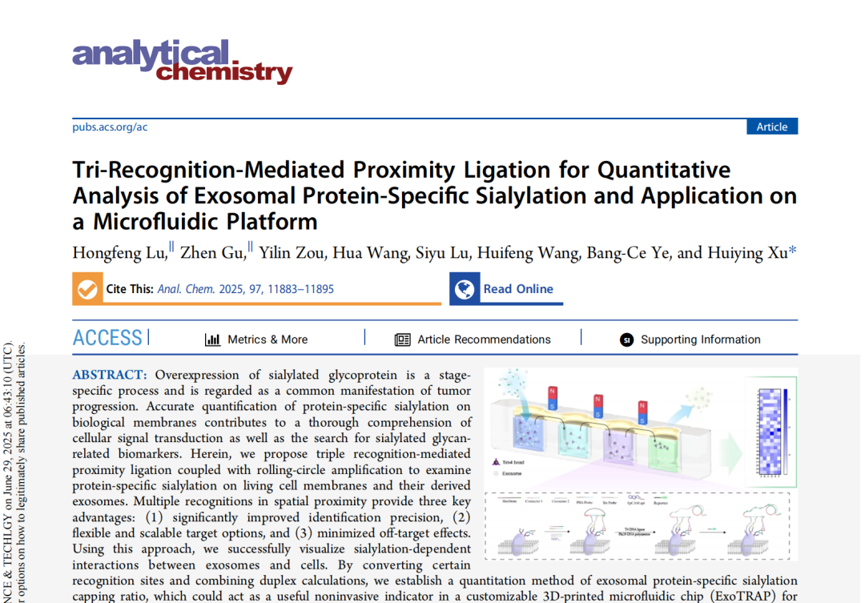
The key innovation lies in a sophisticated "tri-recognition" design. Like opening a lock with three keys at once, the signal is activated only when the target protein, the sialylation site, and the cis-diol site on the glycan chain are recognized simultaneously, thereby reducing misidentification at the source. Prismlab's micro/nano 3D-printed ExoTRAP chip further condenses the full workflow of exosome capture, washing, and detection into a compact platform. It shortens processing time from 24 hours to 3 hours and achieves a detection limit as low as 2.81 x 10^3 particles/mL - comparable to accurately finding a few specific nanoparticles in a liter of water. This combination of precision and efficiency helps bridge the gap between conventional technologies and clinical needs.

Schematic diagram of the ExoTRAP exosome analysis system
3D-Printed Chips: Making Microscopic Detection Traceable and Reliable
The implementation of this technology relies on a key hardware platform: Prismlab's MP-100-6L micro/nano 3D printer. With 5 microns of precision, the system accurately reproduces the complex structure of the ExoTRAP chip, from micron-scale chambers and channels to hydrophobic oil-phase barriers. Every detail contributes to the stability and repeatability of exosome detection.
Why Choose Prismlab Micro/Nano 3D Printing?
Conventional microfluidic chip fabrication relies on processes such as photolithography, which are time-consuming, costly, and limited in their ability to support customized complex structures. Prismlab's micro/nano 3D printing equipment overcomes these limitations:
- Cross-Scale Precision
It delivers 2-micron precision while supporting a large build volume of 55 x 100 x 100 mm, enabling both micron-scale details and hundred-millimeter-level devices to be produced without stitching.
- Material Compatibility
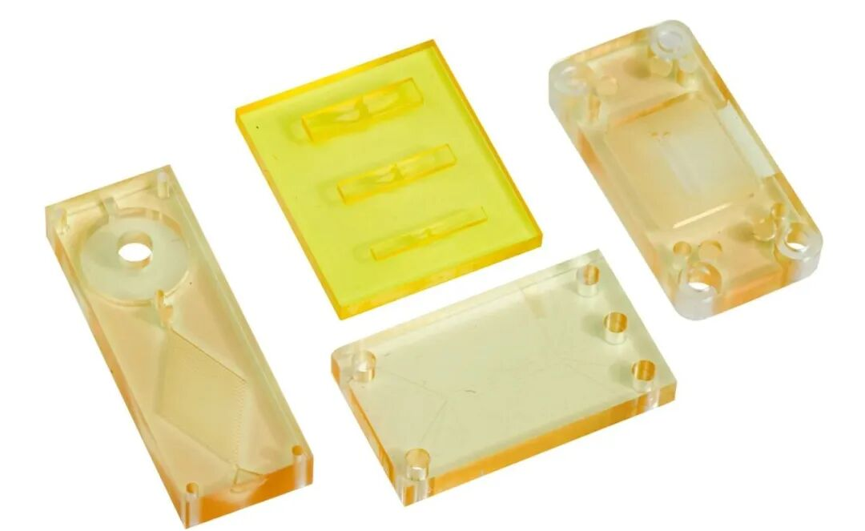
Photopolymer resins: available in high-transparency, yellow, black, translucent and other formulations, with high-pressure resistance for different application scenarios. For example, high-transparency resin can be used for optical detection windows in microfluidic chips to ensure undiminished fluorescence signals, while translucent resin is suitable for devices requiring internal-structure observation.
Ceramic materials: compatible with alumina, zirconia, silicon carbide and other ceramic systems. These materials offer high-temperature resistance and strong chemical stability, making them suitable for chip components that require long-term contact with biological samples or high-temperature reactions.
Metal materials: including stainless steel and other materials with high mechanical strength, suitable for chip support structures or wear-resistant components in contact with fluids.
- Efficient Customization
From design to production, the process can be completed within days, supporting rapid chip-structure adjustment based on clinical needs and accelerating technology translation.
Biotechnology and pharmaceutical innovation are reshaping the future of human health. Prismlab's micro/nano 3D printers can effectively improve the high-throughput screening, precision delivery, and real-time detection performance of microfluidic chips and organ-on-chip systems, accelerating experimental progress and supporting drug production scale-up.
Whether for fine electrodes in precision biosensors or large multi-channel chips for parallel detection, Prismlab's micro/nano 3D printing technology can meet demanding requirements and deliver a true breakthrough in precision, scale, and materials.